2.5. Appendix: Python code
import numpy as np
import matplotlib.pyplot as plt

plt.style.use(['seaborn-ticks', 'seaborn-talk'])
n_energy_levels= 10
reducedTemperatures=[0.5, 1, 2, 3]


def calculateStateOccupancy(T, i):
    # No degeneracy
    #MODIFY HERE
    return 1

def calculateStateOccupancy_s1(T, i):
    # Degeneracy s+1
    # MODIFY HERE
    return 1

def calculateStateOccupancy_s5(T, i):
    # Degeneracy s+5
    # MODIFY HERE
    return 1

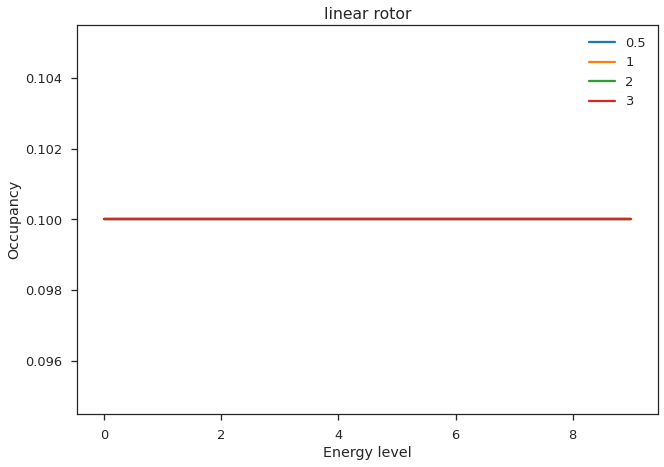
def calculateStateOccupancy_rotor(T, i):
    # Linear Rotor
    # MODIFY HERE
    return 1


functions ={
    "no_degeneracy": calculateStateOccupancy,
    "s+1": calculateStateOccupancy_s1,
    "s+5": calculateStateOccupancy_s5,
    "linear rotor": calculateStateOccupancy_rotor
}

for f in functions.keys():
    fig, ax =plt.subplots(1)
    ax.set_title(f)
    ax.set_xlabel("Energy level")
    ax.set_ylabel("Occupancy")

    calculateOccupancy=functions[f]

    for reducedTemperature in reducedTemperatures:
        distribution = [] # For each state there is one entry
        partition_function=np.float64(0.0)

        for i in range(n_energy_levels):
            stateOccupancy=calculateOccupancy(reducedTemperature, i)
            distribution.append(1.0) # MODIFY HERE
            partition_function+=1.0 # MODIFY HERE

        ax.plot(distribution/partition_function, label=reducedTemperature)

    ax.legend()
    plt.show()
2.6. Comparison linear rotor approximate versus analytical Z
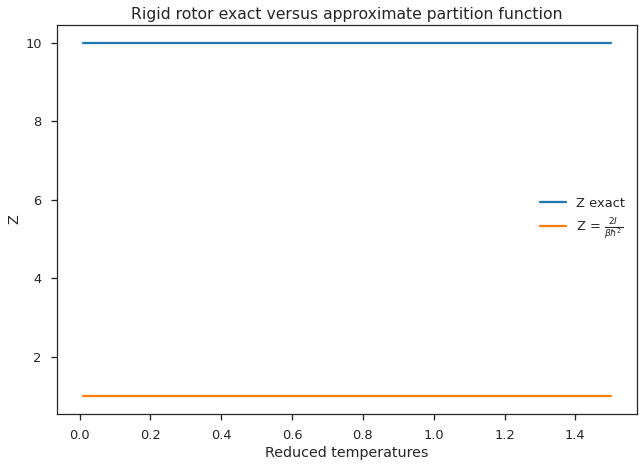
fig, ax =plt.subplots(1)
ax.set_title('Rigid rotor exact versus approximate partition function')
ax.set_xlabel("Reduced temperatures")
ax.set_ylabel("Z")

n_energy_levels = 10
reducedTemperatures=[0.01, 0.1, 0.25, 0.5, 0.75, 1, 1.5 ]

list_of_exact_Z = []
list_of_approx_Z = []

#iterate over reduced temperatures and add Z value for that temperature to list
for reducedTemperature in reducedTemperatures:

    Z=np.float64(0)

    # exact partition function
    for i in range(n_energy_levels):
        stateOccupancy=1 # MODFIY HERE
        Z+=1 # MODFIY HERE
    list_of_exact_Z .append(Z)

    # approximate partition function
    approx_Z =1 # MODFIY HERE
    list_of_approx_Z.append(approx_Z)

ax.plot(reducedTemperatures,list_of_exact_Z, label="Z exact" )
ax.plot(reducedTemperatures,list_of_approx_Z, label =  r'Z = $\frac{2 I}{\beta \hbar^2}$')

ax.legend()
plt.show()