1. Grading and attendance
Please note that your attendance to the exercises is mandatory, during the entire 2 hours of the sessions. All the exercises can be finished within these 2 hours, and the assistants will be with you to answer any questions that you may have. Every set of excercises will be accompanied by a written report.
During all except the first exercise session, each person will spend 5-10 minutes with an assistant where they will be asked questions about the past week’s exercises and the respective report, which must have been handed in as a hard copy at the beginning of the session. The answers to these questions will be graded and, together with the written report, contribute 1/2 to your overall grade. Please note that the last session will be an exception, as the grading will be based on the written report only. All reports need to be handed in two weeks after the respective session except for the last record which is as noted on moodle.
All reports are handed in via moodle.epfl.ch.
Since the scope of this course is limited, each exercise session is accompanied by one or several more involved bonus questions treating theoretical problems of relevance. Solving these bonus questions will give you additional points at every exercise session and can thus substantially improve your final grade of the course.
Although the exercises include some coding , you will not be tested on your
knowledge of the language C++ or Python, but on the understanding of the general concepts
instead.
Your final grade will be based on 5 out of a total of 6 grades.
2. Contents
This list gives an overview of the topics that will be covered during the next weeks.
Statistics: Numerical estimation of \(\pi\) using Monte Carlo methods
Statistics: Statistical Mechanics and the Boltzmann Distribution
Monte Carlo: Detailed Balance in Monte Carlo
Molecular Dynamics: Implementing integrator
Molecular Dynamics: Solvent models and initialization
Molecular Dynamics: MD simulation of a biological system
3. Computer environment
You can use a virtual environment in this course that you can directly launch from the exercise website.
Simply click the rocket button on the top right of the code files and choose either JupyterHub to launch noto.epfl.ch or Colab if you want to launch Google Colab.

On noto.epfl.ch your work will be saved on your EPFL storage. For Google Colab you need to save the work you have done in a Google Drive account (you can use the epfl.ch Google Account for this).
To submit your code download the .ipynb file from noto or Colab.
On noto you right click on the file to download.
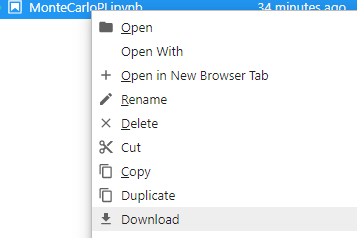
If you prefer to use C++ for the first coding exercises you either need to have gcc compiler installed on your local machine or you can also use noto.epfl.ch. Simply check the instructions given at the top of Appendix: Monte Carlo C++ Program.
Ask the assisstant if you have questions/problems about setting up the virtual environment.
4. Questions
We are here to help - please do not hesitate to contact us outside the scheduled hours. You may contact us by mail or schedule an appointment to discuss with us in person.
If you notice any typos or mistakes in the exercise script, please notify the assistants.
5. References
Background information about the concepts of the exercise can be found in [TA87] and [SF96].
- SSR02
Carlos Simmerling, Bentley Strockbine, and Adrian E. Roitberg. All-atom structure prediction and folding simulations of a stable protein. Journal of the American Chemical Society, 124(38):11258–11259, 2002. doi:10.1021/ja0273851.
- SF96
Berend Smit and Daan Frenkel. Understanding Molecular Simulation: From Algorithms to Applications. Elsevier, 1996.
- TA87
D.K. Tildesly and M.P Allen. Computer Simulation of Liquids. Oxford Science Publications, 1987.